Styrene is one of the core chemicals in modern industry, and its purity directly determines the quality of downstream polymer products. However, the trace impurity of phenylacetylene contained in styrene produced via the petroleum route can hinder polymerization reactions and lead to catalyst poisoning. Therefore, the high-selectivity semi-hydrogenation of phenylacetylene to styrene is a key purification technology. Palladium (Pd) has become a potential catalytic material due to its excellent hydrogen activation ability. However, its surface exhibits strong adsorption towards the product styrene, which can easily lead to excessive hydrogenation and the formation of by-product ethylbenzene, resulting in low selectivity. Traditional crystalline catalysts have heterogeneous active sites, making it difficult to precisely control the adsorption strength of intermediates. Balancing the hydrogenation ability of Pd with the desorption ability of products has become the core challenge in improving the selectivity of phenylacetylene semi-hydrogenation.
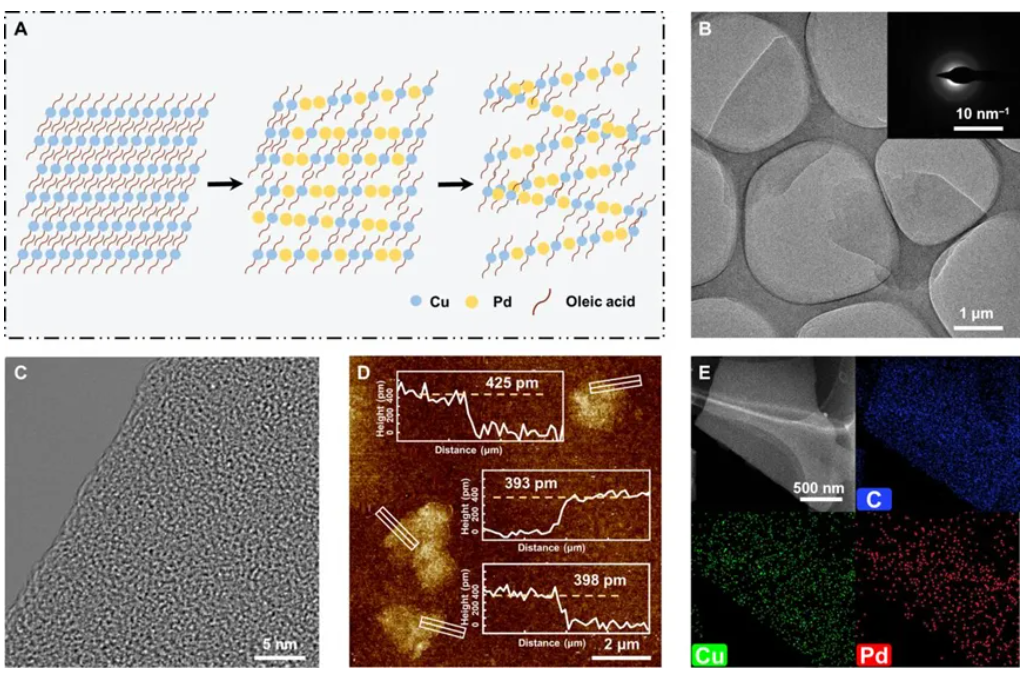
Guo Lin's team at Beihang University has proposed a ligand-confined in-situ amorphization strategy to address the selectivity bottleneck of Pd-based catalysts, constructing an atomic-level monolayer amorphous CuPd catalyst. Under ambient pressure and room temperature conditions, this catalyst achieves a conversion rate of 99.1% for phenylacetylene and a selectivity of 96.2% for styrene, with a TOF value as high as 6004 h⁻¹, combining high activity and stability.
This study not only provides a high-performance catalyst for styrene purification, but also breaks through the regulatory limitations of traditional crystalline catalysts. By utilizing the long-range disorder and tunable electronic properties of amorphous materials, it establishes a new paradigm for the design of a new generation of highly selective heterogeneous catalysts, and provides new insights for precise regulation of active centers in the field of heterogeneous catalysis.
Yang H, et al., Amorphous monolayer CuPd catalysts for selective semihydrogenation. Sci. Adv. 11, eadx8081 (2025).
https://doi.org/10.1126/sciadv.adx8081

