Triplet emitters exhibit great potential in various fields such as anti-counterfeiting and information encryption, thanks to their microsecond to second-order excited-state lifetimes, significant Stokes shifts, and high exciton utilization rates. However, the transition between singlet and triplet states is "spin-forbidden," necessitating effective spin-orbit coupling or specific charge transfer states to achieve intersystem crossing (ISC). Although organic-inorganic hybrid materials can integrate the advantages of multiple components to promote ISC and suppress non-radiative decay, achieving precise atomic-level control over the ISC process remains a significant challenge due to the diversity of components and the complexity of structural topology.
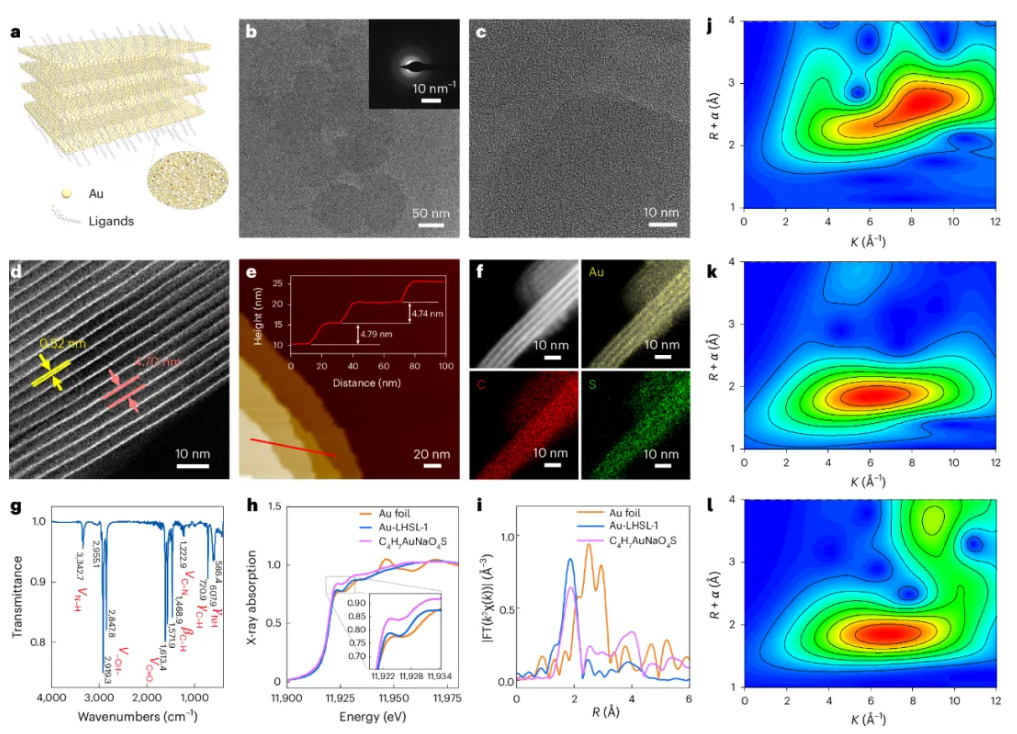
A joint team from Beihang University and the National Center for Nanoscience and Technology has proposed a new strategy for precisely regulating the interfacial charge separation (ISC) process by constructing a gold-based organic-inorganic layered hybrid superlattice. This material consists of alternating layers of atomically thick gold and 4-mercaptobenzamide derivative ligands, allowing for the directional modification of the Au–π conjugation interaction strength by adjusting the interlayer spacing.
Femtosecond transient absorption spectroscopy reveals that the reduction in interlayer spacing shortens the intersystem crossing (ISC) time from over 2 ps to 0.26 ps, with the structural confinement effect significantly promoting ultrafast ISC. Variable-temperature photoluminescence studies estimate a singlet-triplet energy gap of approximately 20 meV, further corroborating the enhanced ISC mechanism. The modular structure of Au-LHSLs provides a new paradigm for atomic-level regulation of spin-orbit interaction and exciton dynamics, enabling precise control over dual emission properties of fluorescence and phosphorescence. This highlights the enormous potential of layered hybrid superlattices as multifunctional material platforms in spin-related optoelectronic applications, opening up new directions for the design of next-generation optoelectronic device materials.
Yang, H., Zhang, Y., Qiu, Z. et al. Layered hybrid superlattices with a regulated intersystem crossing process. Nat. Synth (2025).
https://doi.org/10.1038/s44160-025-00921-5

