Electrochemical nitrogen fixation is a sustainable approach that utilizes renewable energy to convert abundant nitrogen gas into ammonia, holding transformative potential in revolutionizing artificial nitrogen cycles. However, even the most advanced catalytic systems face the issue of insufficient nitrogen adsorption capacity, severely limiting ammonia yield and Faraday efficiency (FE).
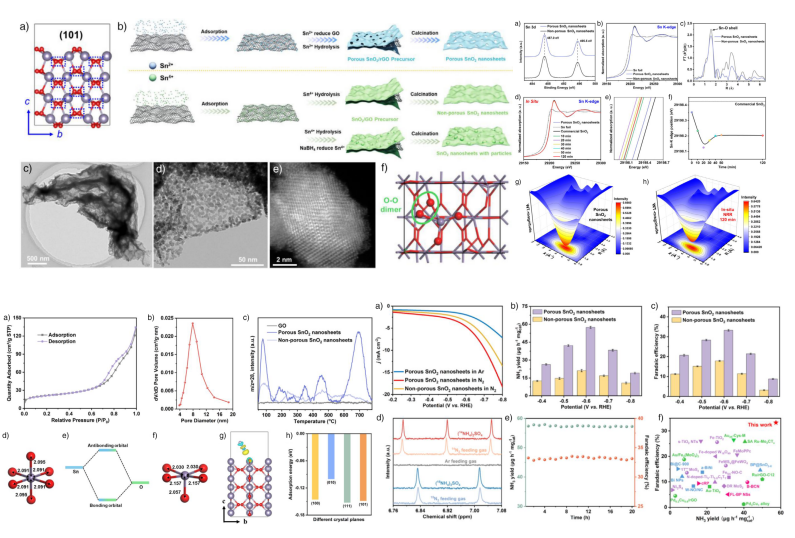
To overcome this bottleneck, the authors ingeniously utilized the antiferroelectric properties of tin dioxide (SnO2) to establish dipole-dipole interactions with nitrogen molecules, synergistically enhancing the adsorption and activation kinetics of nitrogen. Based on this, the authors constructed a three-dimensional (3D) porous tin dioxide network with unsaturated amorphous surfaces. Both experiments and first-principles calculations showed that all exposed antiferroelectric surfaces could effectively adsorb nitrogen, enhancing nitrogen adsorption capacity and maximizing the accessibility of active sites. The optimized catalyst exhibited excellent performance, with an ammonia yield of 57.38 µg h-1mgcat-1 and a Faraday efficiency (FE) of 33.26%, which is one of the highest values reported for aqueous ammonia synthesis catalysts. These breakthroughs not only establish a general design framework for gas-involving electrocatalysts but also pioneer a comprehensive strategy to improve nitrogen utilization efficiency in next-generation sustainable energy infrastructure.
Xiangyu Chen, Shuning Lv, Yue Liu, Hongfei Gu, Xiaoyi Sun, Qi Hu, Yong Zhao, Zhaoyu Li, Tianqi Guo,* Jianxin Kang,* Li-Min Liu,* and Lin Guo*. Antiferroelectric SnO2 Network with Amorphous Surface for Electrochemical N2 Fixation. Angewandte Chemie International Edition, 2025
https://onlinelibrary.wiley.com/doi/10.1002/anie.202515222

